By Trilby
If it feels like everyone is talking about artificial intelligence right now, you’re not imagining it.
Students are using AI to help with homework. Schools are rushing to create AI policies. New AI tools seem to pop up every week.
As teachers, it’s easy to feel like we’re supposed to become experts overnight… But you don’t need a degree in computer science to teach students about AI.
In fact, one of the most important lessons we can teach isn’t how to build AI. It’s about understanding it, questioning it, and using it responsibly.
If you’ve been wondering “What is artificial intelligence?” or “How do I explain AI to my students?” you’re in the right place.
Let’s break it down.
Short on time? Grab a free AI Literacy Activity to use in your classroom today.
What is Artificial Intelligence?
At its simplest, artificial intelligence (AI) is technology that can recognize patterns, make predictions, and complete tasks that typically require human intelligence.
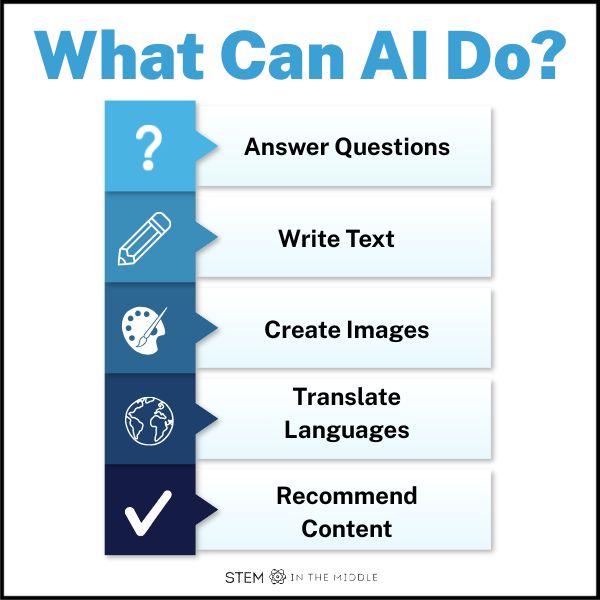
The important thing to remember is this:
AI doesn’t think like humans do.
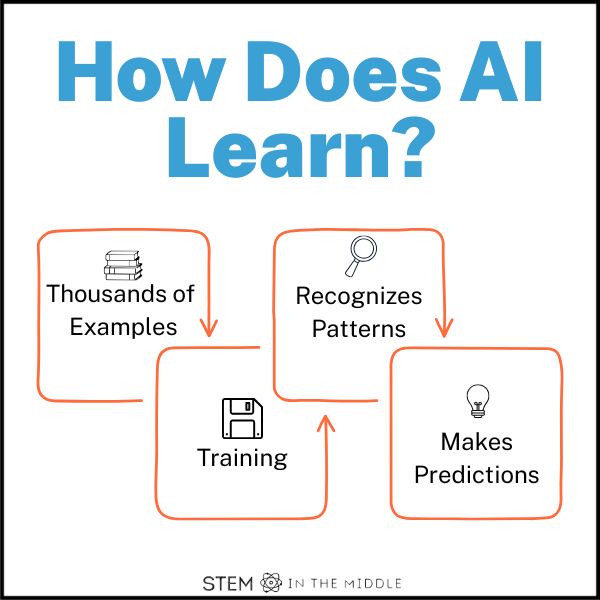
Instead, it learns from huge amounts of data and looks for patterns. That’s why AI can often produce impressive results, but it can also make mistakes.
What AI Is (and What It Isn’t)
One of the biggest misconceptions students have is believing AI “knows” things.
It doesn’t.
Think about your email inbox.
After seeing enough spam messages, you start recognizing the signs: strange wording, too-good-to-be-true offers, or suspicious links.
You aren’t memorizing every spam email you’ve ever received. Instead, you’re recognizing patterns you’ve seen before.
AI works in a similar way. It learns from enormous amounts of data and looks for patterns.
When it receives something new, it predicts the most likely answer based on what it has seen before.
That’s very different from understanding.
How Does AI Learn?
This is one of the most common questions students ask.
AI learns through training data.
Training data is simply a large collection of examples.
Imagine you’re teaching a student to identify trees. You wouldn’t show them just one oak tree. You show them hundreds of different trees. Over time, they begin to notice patterns such as the shape of the leaves, the texture of the bark, and the way the branches grow. Eventually, they can use those patterns to identify a tree they’ve never seen before.
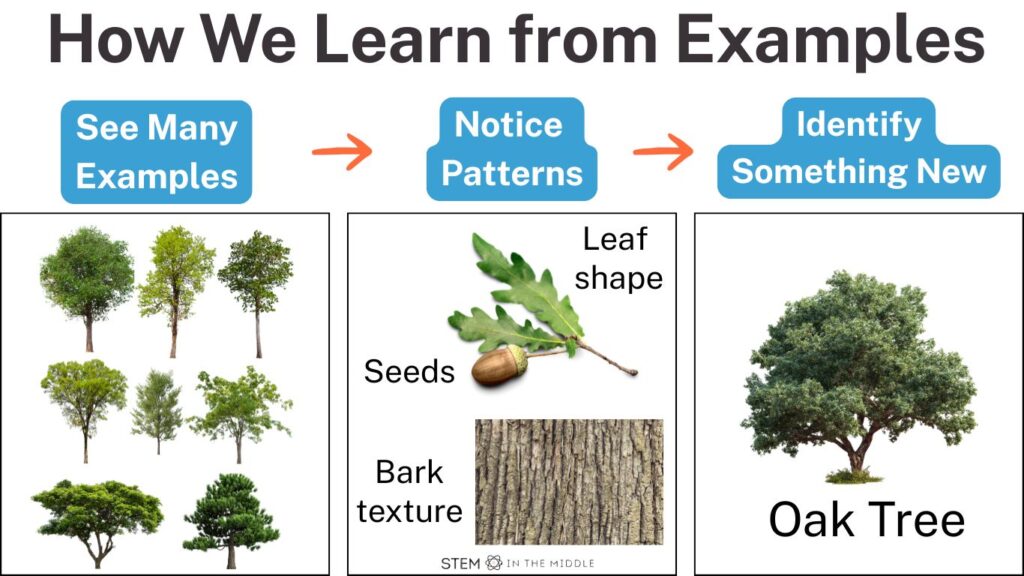
AI works the same way. The more examples it sees, the better it becomes at recognizing patterns, but it’s never perfect.
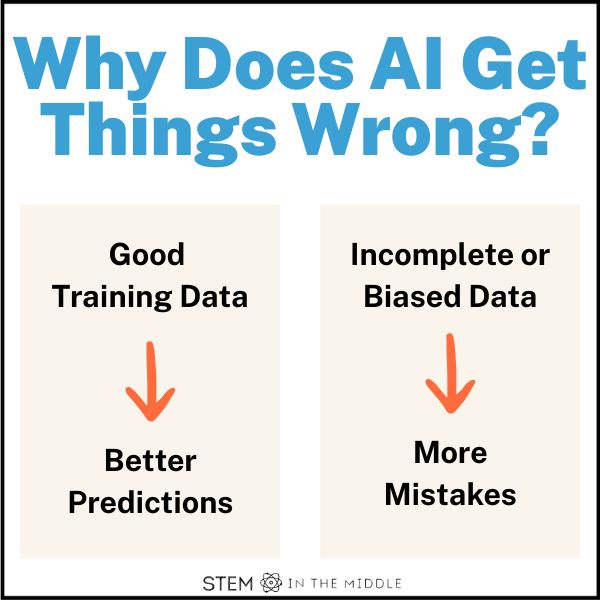
Its predictions are only as good as the data it was trained on. If that data is incomplete, inaccurate, or biased, the AI’s predictions can be too.
That’s why understanding how AI learns is just as important as understanding what AI can do.
Why Does AI Sometimes Get Things Wrong?
If you’ve ever used ChatGPT or another AI tool, you’ve probably noticed that it can sound incredibly confident.
Sometimes that confidence is misleading.
AI predicts answers based on patterns, so sometimes it:
- Gives incorrect information
- Misses important context
- Makes up facts
- Repeats biases found in its training data
That’s why students should learn to think critically about AI instead of assuming every response is correct.
One of my favorite classroom questions is simply:
“Would AI get this right?”
This question encourages students to pause, think, and explain their reasoning rather than blindly accepting AI answers.
Why Teachers Should Teach AI Literacy
You might be thinking,
“This isn’t a technology class. Why do I have to teach AI?”
It’s a fair question.
The reality is that whether you’re teaching science, English, social studies, math, or another subject, your students are already using AI.
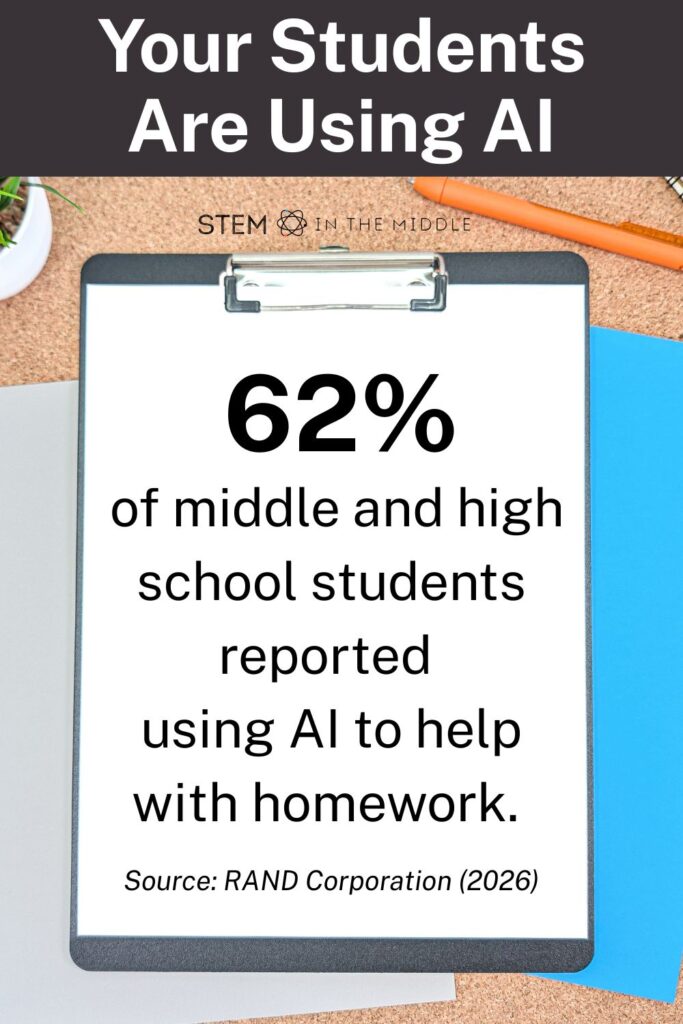
In fact, a 2025 survey by the RAND Corporation found that 62% of middle and high school students reported using AI to help with schoolwork.
They’re using it to:
- Search for information
- Get homework help
- Brainstorm ideas
- Explain difficult concepts
Some schools are encouraging AI use. Others are restricting it. Most are still figuring out what responsible use should look like.
No matter what your school’s AI policy is, students need guidance.
Teaching AI literacy doesn’t mean turning every class into a computer science class. It means helping students become thoughtful users of AI by understanding:
- How AI works
- Why AI sometimes gets things wrong
- When AI can support learning
- When they need to do the thinking themselves
- How to use it responsibly and ethically
These aren’t just AI skills. They’re critical thinking skills, and they’re becoming just as important as knowing how to evaluate a website or identify a reliable source.
A Simple Way to Introduce AI to Students
You don’t need an elaborate lesson to get started with AI literacy.
You can start with a conversation.
Present students with real-world scenarios and ask:
- Would AI get this right?
- Why or why not?
- What information would AI need?
- Could bias affect the answer?
- Would you trust the response?
These discussions naturally lead students toward understanding concepts like:
- Training data
- Pattern recognition
- Accuracy
- Bias
- Critical Thinking
Without getting deep into the technical side of AI.
Free AI Activity for Teachers
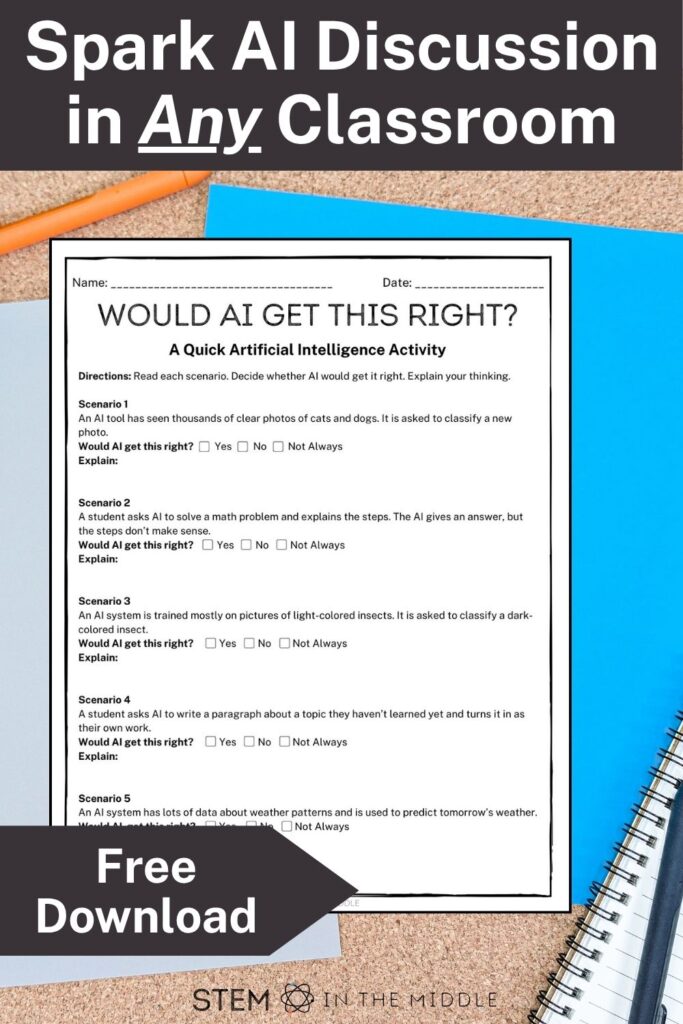
If you’re looking for an easy way to introduce these ideas, I’ve created a free classroom activity called Would AI Get This Right?
Students read five real-world scenarios and decide whether AI would get each one right, then explain their thinking.
It’s a great bell ringer, discussion starter, advisory, or digital citizenship activity that helps students explore how AI learns, why it sometimes makes mistakes, and why responsible use matters.
AI Is Here To Stay
Artificial intelligence isn’t going away.
Our goal shouldn’t be to make students afraid of AI or to convince them to use it for everything.
Instead, we can help them become thoughtful users of technology by asking questions, thinking critically, and understanding how AI actually works.
At the end of the day, most students don’t need to know every technical detail about artificial intelligence. They need the knowledge and confidence to ask, “Can I trust this?”
And that might be one of the most valuable skills we teach.