By Trilby
AI isn’t coming… It’s already here.
And if you’re anything like me, you’ve probably had at least one moment this year (or this week) where you thought:
- “Did my students use AI to complete this?”
- “Is AI helping them… or hurting them?”
Studies show students are already using AI, whether we teach them how or not.
According to a recent report from RAND Corporation, 62% of students reported using AI to help with homework by the end of 2025 (up from 48% earlier that year). Read the RAND report.
At the same time, many students expressed concerns about how AI might impact their learning, especially their ability to think critically.
That combination (high use + uncertainty about impact) is exactly why teaching the responsible use of AI matters more than ever.
Short on time? Grab ready-to-use lessons to teach responsible AI use here.
The Problem: Students Are Navigating AI Without Clear Guidance
One of the biggest takeaways from the RAND report is this:
👉 Students are using AI regularly, but school expectations and guidance are still developing.
The report highlights that:
- Students are actively using AI to assist with their academic work
- There is inconsistent or unclear guidance about when and how AI should be used
- Many students are left to make their own decisions about what is appropriate
And when students are left to figure it out on their own, you get a wide range of behaviors, from thoughtful use to complete over-reliance.
What “Responsible Use of AI” Actually Means
Responsible use of AI does not mean banning it.
Responsible use of AI means teaching students:
- When AI supports learning
- When AI replaces thinking
- How to use it ethically and transparently
A helpful way to frame this (aligned with themes in the RAND research) is:
Cognitive Augmentation vs. Cognitive Offloading
- Augmentation → AI helps students think deeper
- Asking for explanations
- Brainstorming ideas
- Clarifying misunderstandings
- Offloading → AI does the thinking for students
- Generating full answers
- Completing assignments
- Avoiding productive struggle
👉 We want to help students move toward augmentation and away from offloading.

What Students Are Actually Using AI For
The RAND report makes it clear that students are not just using AI to “cheat.”
They are using it to:
- Better understand assignments
- Generate ideas
- Get explanations of difficult concepts
- Support writing and revision
That’s important.
Because it means:
👉 Students already see AI as a learning tool, not just a shortcut.
But without guidance, that use can easily cross the line.
5 Practical Ways to Teach Responsible Use of AI
Let’s make this real for your classroom.
1. Define Clear Boundaries
Don’t assume students know what’s allowed.
Be explicit:
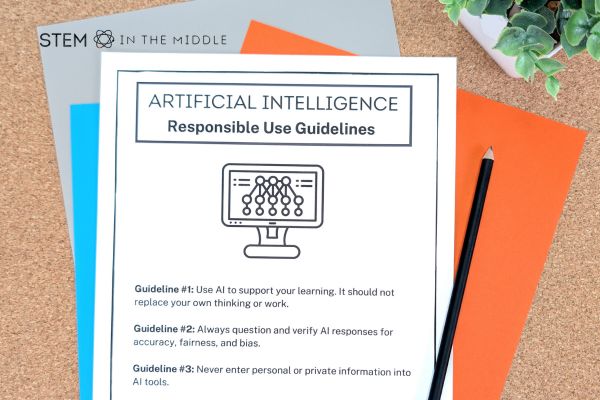
- “You CAN use AI to brainstorm or explain”
- “You CAN use AI to check your understanding”
- “You CANNOT submit AI-generated work as your own”
Clarity = better decisions.
2. Model What Responsible AI Use Looks Like
Students need to see how to use AI as a tool.
Model:
- Writing strong prompts
- Evaluating AI responses
- Spotting errors or bias
Treat AI like a thinking partner, not an answer machine.
3. Build in Reflection
Have students reflect after using AI:
- How did this help your thinking?
- What did you still need to figure out yourself?
- Would you use it the same way again?
This builds awareness and better habits.
4. Design for Thinking, Not Just Answers
Instead of trying to “AI-proof” everything (which isn’t realistic), focus on tasks that require students to show their thinking and engage in real experiences.
What this looks like in practice:
- Hands-on + Physical Tasks
- STEM Challenges (build, test, redesign)
- Lab investigations
- Prototyping activities
AI can suggest ideas, but it can’t do the building or testing.
- Paper + Pencil Thinking
- Quick writes
- Sketching models/diagrams
- Annotating readings
- Planning before using AI
This slows thinking down and makes it visible.
- Process Over Product
- Planning sheets
- Data collection
- Iteration notes
- Reflections
AI can generate an answer, but it can’t recreate a student’s actual process.
- Personal + Contextual Responses
- “What surprised you during the reading?”
- “What would you change and why?”
- “How did your design fail, and what did you learn?”
AI can fake generic answers, but not your student’s experience.
- Structured AI Use (Not Avoidance)
- Use AI to brainstorm → then choose and justify ideas
- Use AI to explain → then rewrite in your own words
- Use AI to check → then correct your own work
Let students use AI with boundaries. This reinforces responsible use of AI.
5. Talk About It
The RAND report emphasizes the importance of explicit conversations with students about AI use and its impacts on learning.
Students are already thinking about this. They just need guidance and a space to discuss it.
A Simple Starting Point (If You Don’t Want to Build It From Scratch)
If you’re thinking:
“This all sounds great… but I don’t have time to create lessons for this right now.”
Totally fair.
That’s why I created lessons focused on helping students understand and practice the responsible use of AI in a way that actually clicks.
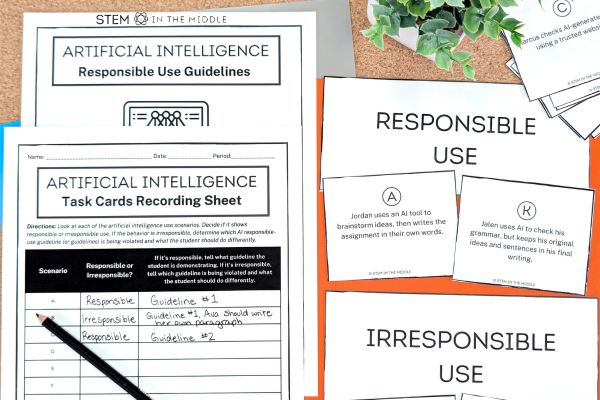
These activities include:
- Student-friendly AI policy exploration
- Real-life scenarios and discussions
- Clear examples of appropriate vs. inappropriate use
- Low-prep activities you can use right away
Looking Forward
AI isn’t going away.
And students don’t need us to control it.
They need us to teach them how to use it responsibly.
Because when students understand the responsible use of AI, they don’t just complete assignments…
👉 They become stronger, more independent thinkers.
Works Cited
RAND. (2025). More Students Use AI for Homework, and More Believe It Harms Critical Thinking. RAND Corporation. https://www.rand.org/pubs/research_reports/RRA4742-1.html